Friday, April 25, 2014

Hold the Grains, Please

First of all I offer my unlimited obeisances to the lotus feet of my Guru Maharaja. Begging for his blessings, I hope to post something of value. 


My Param Gurudeva, Sri Srimad Bhaktivedanta Narayana Goswami Maharaja, in the book, Vaisnava Etiquette, instructs, "Among all vows undertaken by Vaisnavas, Ekadasi (11th day after the new moon and 11th day after the full moon during which we fast from grains and beans) is is most important day for everyone, irrespective of caste, creed, varna, society, male, female, child, old must observe this vow.
     Many people from around India came to Vrindavan today to perform parikrama, as it is auspicious to circumambulate the Dham on this holy day. It is not unusual to see parents carrying their small children on parikrama, too, since so many Indians understand the value for their young ones (see pic below). Today this mother walked 10 km (6.2 miles) holding her baby-- and if you do not think that is enough of an austerity, she is also doing this barefoot! This fortunate child has the opportunity to build her sukrti (spiritual credit) from a very early age... Guru Maharaja has said that our first guru in life is our mother. If she has strong values and character, we stand a good chance of following suit. And vice versa holds true as well.

Mother taking her baby on Ekadasi day parikrama
     Also, my Guru Maharaja tells us that we are not even human if we do not chant at least 16 rounds of Hare Krishna Mantra each day, and furthermore he says we are not Vaisnava if we do not follow Ekadasi. So these two things are so important. Just how important is Ekadasi? Krishna Himself tells us:

ekadas vratam yestuh krtam bhakti samanvite
taih ca yajna krta sarve vratani saphalani ca
                                      (Padma-purana, 22.63)
 
     "If anybody follows this vrata with devotion [doing it for the pleasure of Sri Krishna], then he will get the result of performing all sacrifices and all other penances. Therefore there is no comparing Ekadasi with anything else."

Click here for the Vaisnava calendar, which lists days of Ekadasi. First select your Time Zone and then click "Get Calendar":

Thursday, April 24, 2014

What's Not to Love: Part 2

 First of all I offer my unlimited obeisances to the lotus feet of my Guru Maharaja. With his blessings I hope to post something of value.

Yesterday I wrote about how in general people here are very trusting, simple, and generous to other people. Today a couple scenes inspired me to mention how residents of Vrindavan extend that ideal to the animal species as well. As I started morning parikrama, I snapped a shot of someone feeding the monkeys, which is a common sight in Vraja Mandala. It is called monkey seva (service). See the monkey in the foreground walking away with bread in his mouth? Two monkeys are on their hind legs with arms extended to receive their alms.
Monkey seva
     Also, cows wander the streets here. Like this cow (see pic below), many cows stand at the doors to temples, private residences or shops waiting to receive prasadam. Giving to the cows is called go-seva, (cow service).
Cow standing outside residence waiting to receive alms
     These are just a few displays of of how Vrajavasis realize that all living beings are important; inside every heart of every living being is the eternal soul, the jivatma, part and parcel of Sri Krishna (Bhagavad-gita 15.7).
     Cow is especially honored in India because she is considered one of our seven mothers; she is providing milk to us. The other six mothers are (1) our biological mother, (2) nurse, who helps raise us, (3) Mother Earth, (4) the wife of the king, (5) the wife of our teacher or guru and (6) the wife of a brahmana (Srimad-Bhagavatam, 1.11.28).
     The animals here are very lucky because they are getting the chance to eat prasadam (food offered to the deities) and constantly hear the Hare Krishna Maha Mantra; it is sung in temples, in homes, and often a parade of devotees walk the streets singing it. But the animals cannot chant the mantra, so they are not as fortunate as those of us in the human form of life who have the opportunity to chant Hare Krishna Hare Krishna Krishna Krishna Hare Hare Hare Rama Hare Rama Rama Rama Hare Hare, which is the method for making spiritual advancement in this day in age (Caitanya-caritamrta, Adi-lila, 7.76).


Wednesday, April 23, 2014

What's Not to Love?

I offer my unlimited pranamas to my Guru Maharaja, Sri Sripad Bhaktivedanta Damodara Maharaja.

 Sometimes it's the simple things in life, the little gestures that go a long way. Since I arrived, the Vrajavasis have been surprising me time and time again with their simplicity, inherent trust in others and generosity. What seems like overly generous/sweet/simple to us (Westerners) is simply the norm for Vrajavasis.
     For instance, today I went to the little shop that sells dairy products to purchase fresh milk and yogurt. A side note in case anyone is wondering- yes, the milk is freshly delivered directly from the cows to the shop, which is rare to find in the United States (except one place I know, Gita Nagari ISKCON farm in Central Pennsylvania, has raw milk available). So I tried to pay, but the bill I had was too large; they did not have change. The boy working there said, "No problem, bring it later." A lot of vendors are like that.... without even a second thought or giving that questioning, doubtful look - like when someone raises one eyebrow trying to discern whether or not we are trustworthy - he just assumed that of course I would return later to pay. How simple, right? 
Shopkeeper at the dairy shop smiling big
     Another standard in Vrindavan is that many temples provide prasadam (food that has been offered to the deities-- yes, the deities eat regular meals throughout the day!) to people who visit; sometimes there are set times, other times they distribute prasadam at random to people who come for darshan (seeing the deities). So it is not possible for someone in Vrindavan to go hungry.
People lined up outside a temple for prasadam
    Even though there are countless examples I could mention, one last one I will share is that whenever there is an Appearance or Disappearance Day of a great Vaisnava, temples will hold festivals open to everyone- there will be decorations, a feast, kirtan, and hari-katha to honor that Vaisnava. Everything is for the Vaisnava's enjoyment, but the people who partake receive the remnants. Oftentimes as well, a person or family will sponsor a feast in honor of the day their loved one was born or passed on. This is done as an act of charity on behalf of their beloved. At that time, they typically give rupees in charity to all the guests. So the culture here is to give gifts on birthdays instead of receive them. In my attempt to do such a thing on my birthday in 2013, I did get gifts for others... but I also bought gifts for myself :/... I guess we all have to start somewhere.
Some rupees I received in charity from attending Appearance/Disappearance Day events
Finally, I will end by providing a little taste of how the parents of Sri Krishna gave in charity on His Appearance Day (source: Hari-Katha Tour Report Hidden Treasure 00):

"In pursuance of the Vedic tradition where Nanda Baba and Yasoda Maiya distribute charity on this day, devotees spontaneously joined in the festivities and distributed colossal amounts of maha-prasada to their 15,000 guests. For many weeks, the sannyasis and brahmacaris had been begging door to door in the blazing heat of the sun in order to collect the ingredients for Nanda Baba’s festival, and so many rooms had been filled with the collected provisions. All the ingredients were now transformed into sabji, puspanna, kichories, puries, laddhu, bundi, chutney, fruit salad and other preparations that are very dear to Krsna. When all the preparations had been offered, the devotees opened the gates to let in the first four hundred pilgrims, and so it went on for five hours. Also, 5,000 parcels of maha-prasada preparations were prepared to be distributed to all the families, friends and well-wishers of the Matha who were unable to attend the festival. In this way the Grand Festival of Nanda Maharaja was celebrated with uncommon enthusiasm."

Tuesday, April 22, 2014

In Honor of Great Uncles

First of all I would like to offer my unlimited pranamas to my Guru Maharaja, Sri Sripad Bhaktivedanta Damodara Maharaja. Please bless me to post something of value.

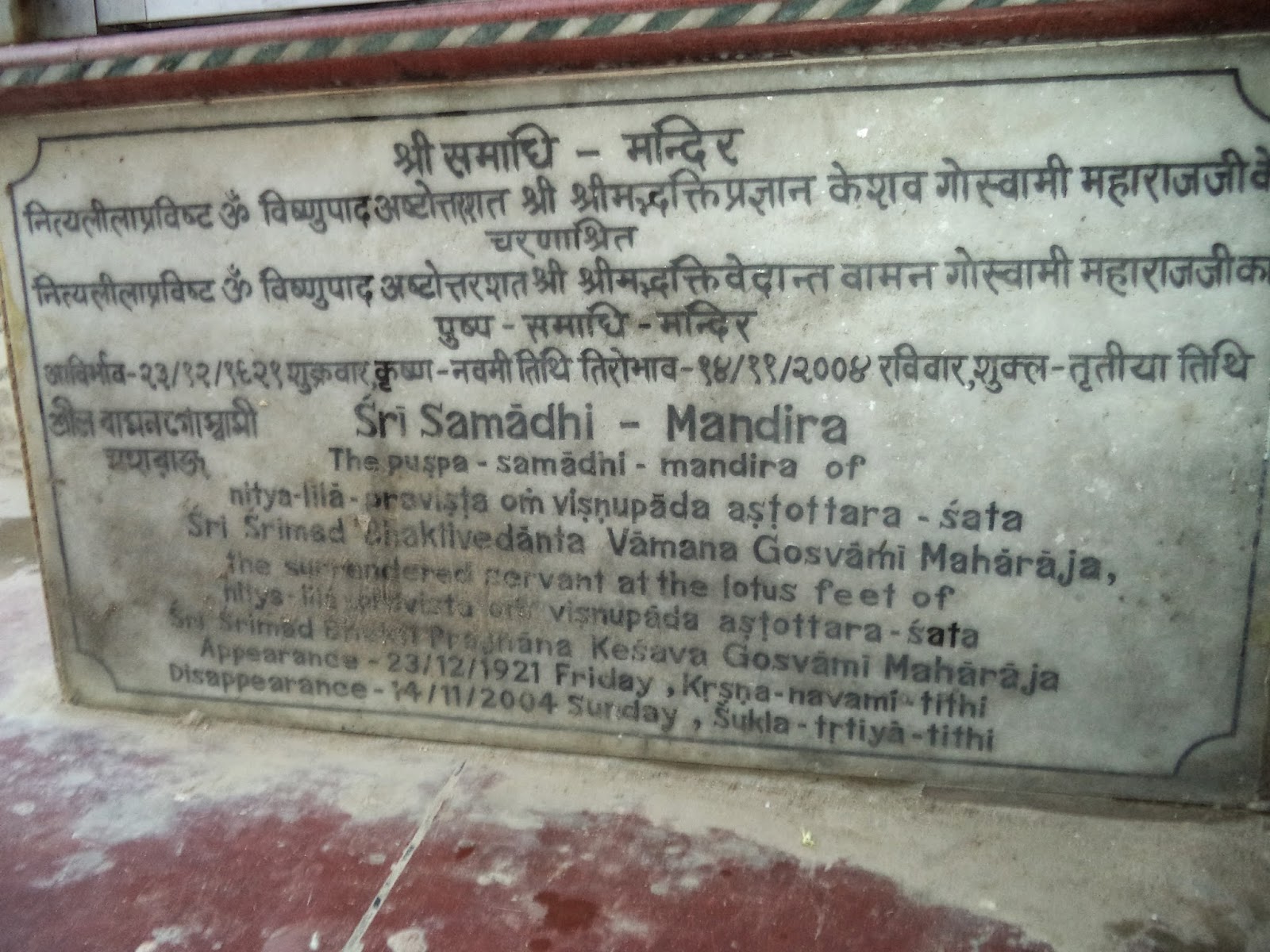
This morning I visited various temples. While at Radha-Damodara temple, a brahmacari was cleaning the pushpa-samadhi of Sri Srimad Bhaktivedanta Vamana Gowami Maharaja, so the door was open (see pic below). It is custom to give obeisances at the samadhis and pushpa-samadhis, so I did. Many times my obeisances are mechanical and rote, there is not much thoughtfulness that goes into them, but this time I took the time to consider a little bit about who this Acarya is.

Pushpa-samadhi of Bhaktivedanta Vamana Goswami

Appearance: 21/12/1921 and  Disappearance: 14/11/2004
         First of all I realized that in the spiritual line, he is the equivalent of my great uncle, being the god brother of my Param Gurudeva (grandfather), nitya-lila-pravista om visnupada Sri Srimad Bhaktivedanta Narayana Goswami Maharaja. I started to consider that my great uncle in my birth family, Uncle Joe, is one of my best friends. Great uncles seem to hold a unique position. The are loving and supportive off us, not seeing the faults in us but only the good- so in that way they are are similar to grandparents. But they are a little more removed than grandparents, which makes room for them to be our buddy, too. Also since they are older and have loads us life experience, they are like guru.  Does this hold true for most families, I wonder?
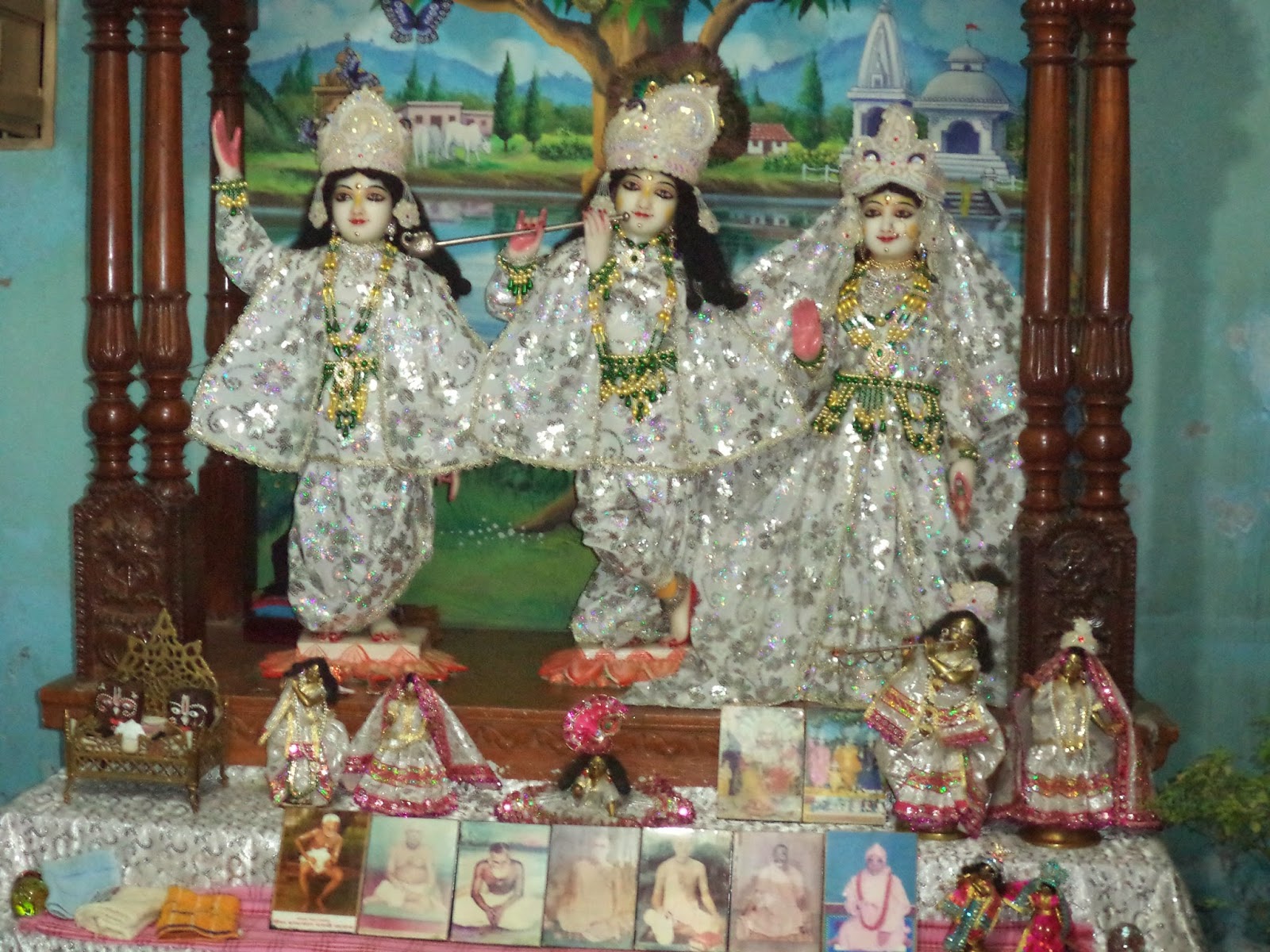
Close up of Radha-Gopinathji and Lord Caitanya
     What I remember most (from hearing and reading) about Bhaktivedanta Vamana Goswami's life is the selfless love his parents had for him and the Gaudiya Math. His mother was a disciple of jagad-guru Sri Srimad Bhaktisiddhanta Saraswati Goswami Prabhupada, and his father was a disciple of Srila Bhakti Prajnana Kesava Goswami Maharaja. From infancy, they could see that their son was very patient, peaceful, intelligent and religious (from the book Acarya Kesari Sri Srimad Bhakti Prajnana Kesava Goswami Maharaja: His Life and Teachings). So when he was just nine years old, his mother fully entrusted her son to the care of Srila Bhakti Prajnana Kesava Goswami Maharaja- she donated him.
    I don't know all the intricacies of giving a child to a math (temple), however, I believe it is not something that can be undone nor can it be negotiated, like "Oh I want to see my son a couple times a year." It is not like that. It is forever, all tangible bonds are dissolved, and essentially, she offered her child to the greater good- to serve Vaisnavas, serve Sri Krsna, and essentially to serve the world. Can you imagine how must faith it takes to offer your child like that?! My Guru Maharaja has said, "A mother and father who keep us from bhajana (prescribed process for spiritual growth, e.g., chanting Holy Name) are not real parents, that is real maya (illusion), whereas a mother and father who help us in bhajana, that is not maya."
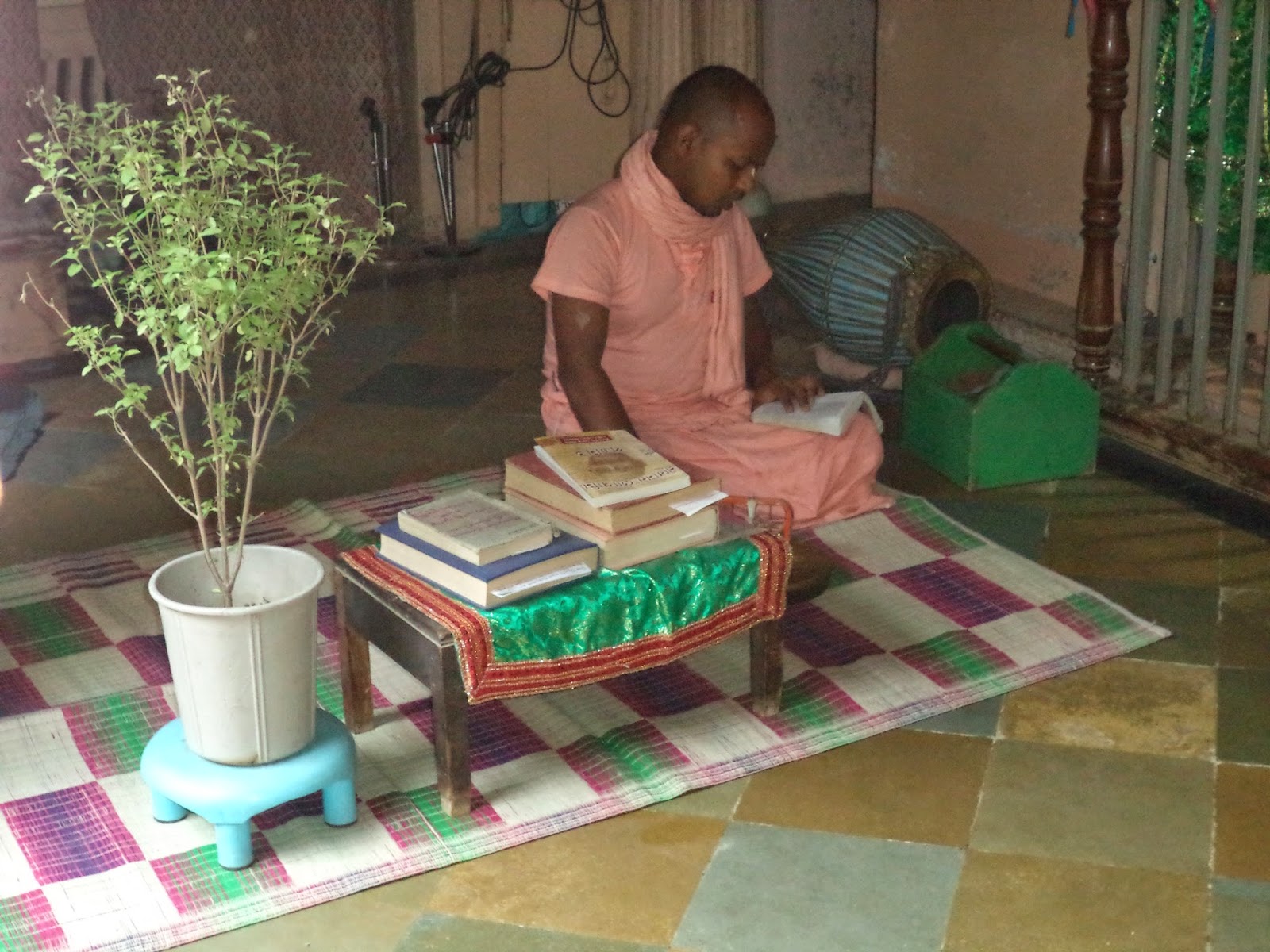
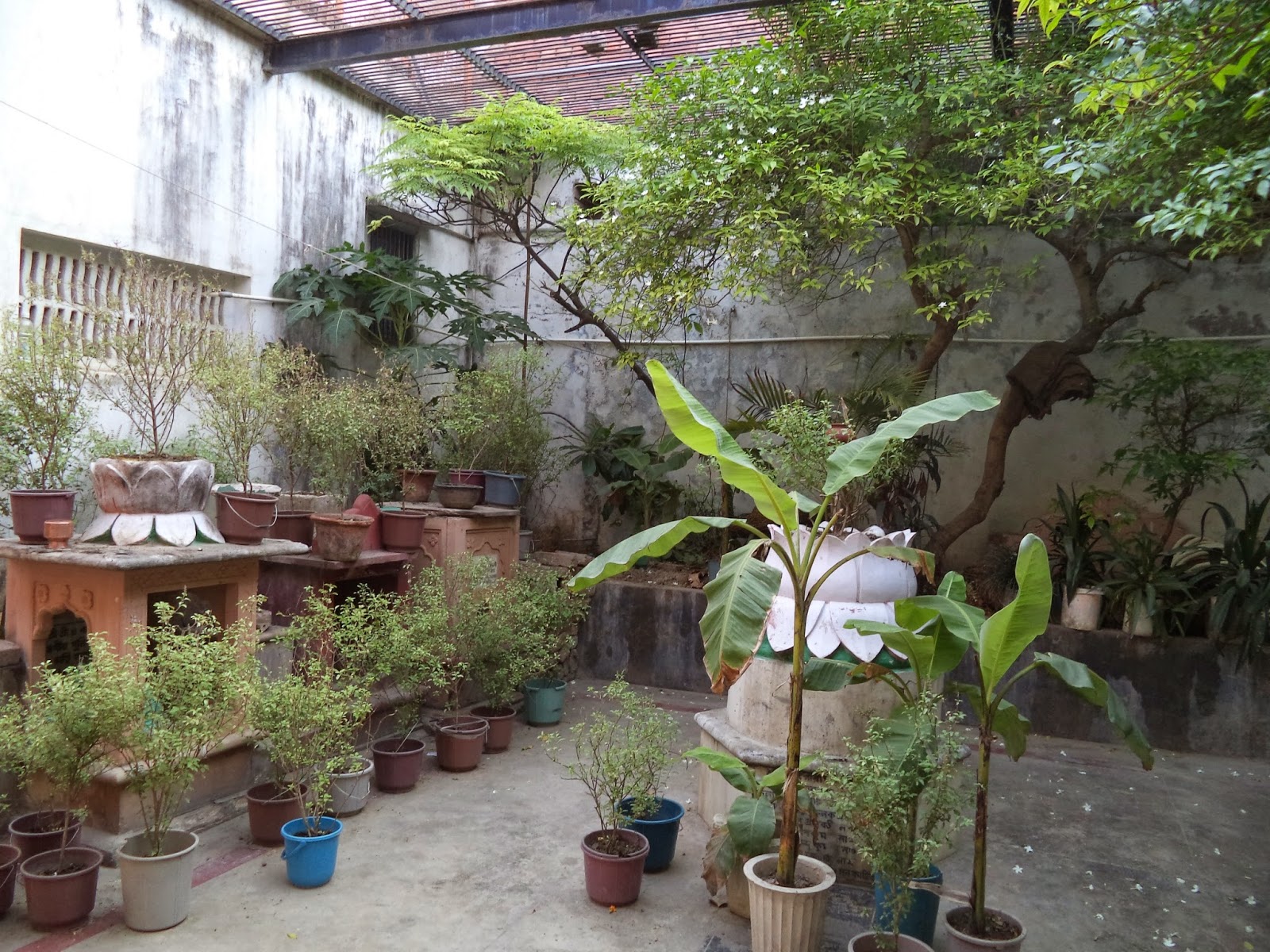
      ...After Radha-Damodara I visited Sri Gopinath Ji Gaudiya Math, established by Bhaktivedanta Vamana Goswami. Here are beautiful deities, a serene courtyard, and nice morning bhajanas (see pics below).
Sri Radha-Gopinathji on right and Lord Caitanya on left

Brahmacari singing bhajanas (songs) for the deities
Courtyard with many Tulasi plants
Devotees may want to read the three prayers to Bhaktivedanta Vamana Goswami Maharaja (source: Sri Gaudiya Giti-Guccha):

namah om visnu padaya kesava presthaya bhutale
sri-srimad bhaktivedanta-vamana iti namine

I offer pranama to om visnupada Sri Srimad Bhaktivedanta Vamana Goswami Maharaja, who in this world, is most dear to Sri Kesava-deva (or Sri Srimad Bhakti Prajnana Kesava Goswami Maharaja)

guru-dhamni ca sevasu vasnave sarvada mati
granthe bhagavate saksat goswami vedante rati

His heart is perpetually devoted to the service of sri guru, the dhama, and the Vaisnavas and he has unalloyed attachment for Gaudiya Vedanta, Srimad-Bhagavatam, and the literatures of the Goswamis.

gaura-bhava-mayo dehah ujjvala-rasa-bhavakah
bhaktivedanta vamano raga-bhakti-pravartaka

Srila Bhaktivedanta Vamana Goswami Maharaja's divine form is comprised of gaura-bhava, he is immersed in ujjvala-rasa, and he establishes raga-bhakti.

Jaya Bhaktivedanta Vamana Goswami Maharaja!

Monday, April 21, 2014

More than Meets the Eye

First of all I offer my unlimited pranamas to my Guru Maharaja, Sri Sripad Bhaktivedanta Damodara Maharaja in hopes that I can post something of value.

Today Lalita Priya dasi from California and I went on Vrindavan parikrama together. We had a theme during parikrama - to walk around as many trees as possible. For those new to the concept of parikrama, let me explain. Parikrama marga (path) is essentially a loop around Vrindavan Dham. The idea is to circumambulate the entire Dham. It is not only auspicious to circle the Dham itself, but also the residents, temples, people, animal and plants, which are all included.    
     Lalita Priya and I made it a point to walk around nearly every tree we encountered to reap the benefits of including it in our loop. By paying attention to the trees, we discovered many new sights. It is kind of like when someone we know gets a new car - maybe a type we never heard of before - all of a sudden we see that make and model everywhere we look. So even though we have done many parikramas in the past, so many trees became apparent that never stood out (to us) before.
     What became quickly evident was that when the residents of
the Dham build roadways, fences, houses or other structures, the trees do not get chopped down. Instead they get incoporated into the structure or else they simply build around the tree (see pics).What a beautiful lesson! Why is this so prevalent here? Probably because to be a true Vrajavasi means to realize that all beings have souls. Especially here in the Dham, souls are very advanced. In other words they have a very advanced or pure consciousness (Krishna consciousness). This holds true for even the grass, trees, plants, animals, what to speak of the people. So people are careful not to walk on grass, what to speak of chop down a tree.
     Here are two quotes I would like to share:


Srila A.C. Bhaktivedanta Swami Prabhupada writes in his commentary on the Srimad Bhagavatam (6.16.43), "...such civilized men do not discriminate between trees, animals, human beings and other living entities. panditah sama-darsinah: [Bg.  

5.18] because they are completely educated in Krishna consciousness, they see all living beings equally. Äryans do not kill even a small plant unnecessarily, not to speak of cutting trees for sense gratification. At the present moment, throughout the world, killing is prominent. Men are killing trees, they are killing animals, and they are killing other human beings also, all for sense gratification. This is not an Äryan civilization. As stated here, sthira-cara-sattva-kadambesv aprthag-dhiyah. The word    aprthag-dhiyah indicates that Äryans do not distinguish between lower and higher grades of life. All life should be protected. All living beings have a right to live, even the trees and plants."

This quote is from Bhakti-rasayana, Chapter 5: "In appearance the trees and creepers of Vrindavan seem to be ordinary, but upon seeing Krishna they became overwhelmed in bhava. With great joy they offered pranama to the feet of Krishna by offering their fruits and flowers, and they shed tears of love in the form of streams of honey. Even the plants and trees of this world have feelings; like us they are conscious. They are not able to express their feelings in words, but they can express them. Especially the trees and creepers of Vrindavan are all visuddha-sattva, meaning that they are superior to those of us situated in mixed goodness. So what won’t they understand? They can understand and experience everything. Therefore by offering their fruits and flowers in ecstatic rapture, they offered pranama to Krishna." 


Sunday, April 20, 2014

Dancing on Heads

Today we did Vrindavan parikrama (circling Vrindavan on foot). The distance is 10 km (6.2 miles). Along the way are intriguing pastime places and temples. Each parikrama seems to provide a new insight into a place I have already been, or I am blessed to discover a new place altogether. Today we stopped at Kaliya Ghat, a pastime place of Krishna.
    When Krishna had pastimes in Vrindavan (5,000 years ago), he was a cowherd boy. At first, it may sound far-fetched that the Supreme, Original Personality of Godhead herds cows, but don't forget Jesus was a shepherd, so like Father, like Son. One day the cows and His cowherd friends became very thirsty, so they stopped at the Yamuna River to drink. Unbeknownst to them, there was poison in the water spewed from the black serpent, Kaliya, and they fell deathly ill. Krishna provides protection, though, to His dear cows and friends, so He took action....
    The whole area became contaminated, killing all the nearby trees and plants except one kadamba tree (a kadamba is a round yellow flower found only in the Vrindavan region) remained unharmed. This tree still stands today and is immortal, being here for at least 5,000 years so far. That's right- immortal, like vampires, the Noldor Elves of Middle Earth, and like Elvis ;) So Krishna climbed to the top of this tree and leaped into the Yamuna River, which at that time had flowed here (now she is a few hundred yards away).
Immortal kadamba tree Krishna climbed and jumped off to subdue Kaliya
     Kaliya had about 100 hoods. For about two hours Kaliya held Krishna captive, wrapped in his coils, as all the Vrajavasis watched in dismay; some weeping, others fainting, some on the verge of death watching this scene. When the Vrajavasis couldn't bear it anymore, Krishna expanded His body, causing Kaliya great strain, forcing him to release his grip. Very angrily, Kaliya expanded his hoods, exhaled poisonous fumes from His nostrils, set his eyes ablaze like fire, shot fire from his mouth, and licked his lips with his bifurcated tongue. But Krishna quickly pounced on him; it appeared as though He was dancing on Kaliya's hoods. Dancing expertly and avoiding all Kaliya's attempts at attack, Krishna dashed the serpent's head until he had spewed out all his poison.
     Seeing their husband on the verge of death, the wives of Kaliya came to offer prayers and obeisances to Krishna and begged for the life of their husband. Upon hearing their prayers, Krishna released Kaliya, who then submitted himself to Sri Krishna.
Krishna dancing on Kaliya; Kaliya's wives offering Him garland and lotus flower
     So what is the point of this story? Kaliya was full of poison, or envy, which makes him forget Sri Krishna, forget God. Because of this forgetfullness, all waters, lands, plants, animals and people became contaminated and were suffering or dying.
     Krishna, by this act, was actually showing affection to Kaliya, as evident in the prayers of the wives, who say, "...because You are the Absolute Truth, there is no difference between Your mercy and punishment. We think, therefore, that this apparent punishment to Käliya is actually some benediction. It is already clear that this creature appearing in the body of a serpent must have been overburdened with all kinds of sin."    Furthermore, in Kaliya's prayers to Sri Krishna, he says, "My dear Lord, I have been born in such a species that by nature I am angry and envious, being in the darkest region of the mode of ignorance....You are therefore the original creator of all kinds of modes of material nature by which the universe is created."
     So Krishna actually has helped free Kaliya of his acquired nature and bring him to remembrance of God, of Sri Krishna. For this reason, affection and love can be found at the root of this pastime story. For anyone who is interested, the full pastime story can be found in Krsna, The Supreme Personality of Godhead Volume1, Chapter 17, Subduing Kaliya.
 This protruding root of the kadamba tree has a heart shape in it!!!
.

Saturday, April 19, 2014

I Heart Vrajavasis

As I have had the great good fortune to be in Vrindavan Dham for eight months now, engaging in bhakti-yoga at an ashram. I promise no amount of words or pictures can describe the Dham, the Vrajavasis (residents of Vrindavan), the culture and the mood here. Actually even being in the midst of it, it still remains intangible and ever-changing. Maybe that is why I have been so silent for so long. If I cannot grasp this place, this experience, and what I am hearing in hari-katha (hearing about Krishna), how can I try to share them with anyone else? Plus, to what extent do I openly share the things very near and dear to my heart? However, I pray to Guru and Gauranga that I can post something of value and let my family, friends, and well-wishers know something of my engagement here-- there are so many people back home who have supported and inspired my decision to set off on this journey, who are taking care of my doggie, storing my furnishings, receiving my mail, etc. If not for such great people in my life, I would not be in Vrindavan. So for them and others who may be interested in this topic, here goes my first blog post...
Radha Lalita Madhva
     Probably four out of five people who walk the streets of Vrindavan own a t-shirt that says, "I lost my heart in Vrindavan". That pretty much sums it up. What is the reason for losing our hearts? Simple- because of love. No matter where you are in the Dham, you can always hear "Radhe Radhe", "Hare Krishna Hare Krishna", kirtans resounding, san-kirtans, and aratis. Most buildings are actually temples, and behind every residential door, the family is serving their deities. Everywhere you look, you see spiritual paraphernalia- in shops and temples, what people are wearing, etc. All these sounds and paraphernalias are indicators of the mood here- the Vrajavasi's love for Sri Sri Radha-Krishna and reminders of Their love for us. It is hard to forget The Divine Couple, even for a moment in the land of Vrindavan.
     But Sri Krsna and Srimati Radharani only appear to us (well, those of us in the majority who have only material vision) in the deity form. We cannot interact with them. So Krsna mercifully sends His representatives, the pure devotees (Srimad-Bhagavatam, 4.28.55). They are living simple, saintly lives - their only aim for living and breathing is to lovingly serve the highest aim of life, Bhagavan Svyam Sri Krsna Himself. While I cannot realize the immense love that Sri Krsna has for me, I can, at least to some extent of my limited capacity, see and experience the pure love of His devotees who are trying to help guide all of us back to Him, as Srila Swami Prabhupada says, "Back home, back to Godhead". These pure devotees not only love Krsna and Radharani with all their hearts, they love each and every living entity, too, understanding that all are Krsna's parts and parcels (Bhagavad-gita, 15.7).
     Vrindavan is Rhadarani's land- She who has the topmost love for Sri Krsna. It is a place of associating with saintly people and a safe-haven for us when we are ready to start the process of reawakening love in our hearts (Caitanya-caritämåta, Madhya 22. 107) - pure love, not selfishly motivated, material lust that we experience in our Western, materially-minded relationships. And it is reawakened through the process of bhakti-yoga, mainly chanting the maha-mantra, Hare Krishna, Hare Krishna, Krishna Krishna, Hare Hare, Hare Rama, Hare Rama, Rama Rama, Hare Hare. In one respect it is a very inward journey, a time to heal, grow and try to discover who I really am. In another respect it is a very outward process, building friendships with other devotees and learning to treat others with utmost respect and kindness.
     So, in a nutshell, I am in Vrindavan hearing from saintly people and aspiring devotees, chanting the Holy Name, and remembering Sri Sri Radha-Krishna with the hope that one day, one life, I can follow in the footsteps of the Vrajavasis. I am also engaged in book seva, helping to publish in English (and all other languages) the spiritual books of India - of our guru-parampara - which I know will give so many people who have never before had access to these transcendental books peace of mind and open new ways of thinking.
    Those who know me best, I hope you are smiling and thinking, "Of course she is." ;)